Obsession with Pimples · Ingrown Hairs
The RoomObsession with Pimples / Ingrown Hairs is a recurring fixation of the Unnamed protagonist in his prison cell, where a cheek blemish becomes an object of sustained scrutiny, frustration, and attempted control. Its importance lies not simply in the discomfort it causes, but in the way the narrative makes a small, stubborn physical problem absorb his attention: he checks it in the mirror, returns to it after failing to clear it, and eventually spends an extended period trying to remove what he identifies as a hair growing inward. The relief of success is temporary. Another blemish remains, and the possibility of starting the cycle again is already present.
The Cell, the Mirror, and the Blemish
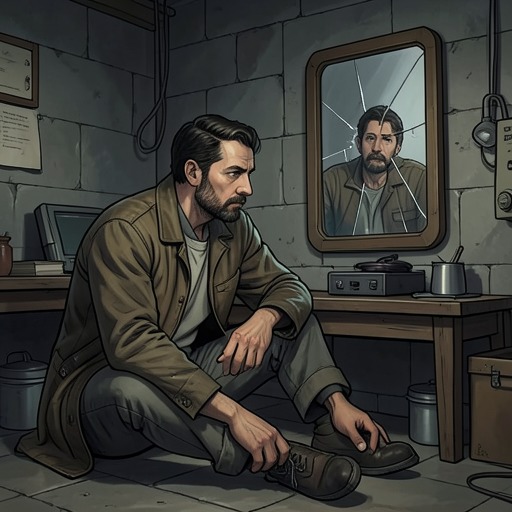
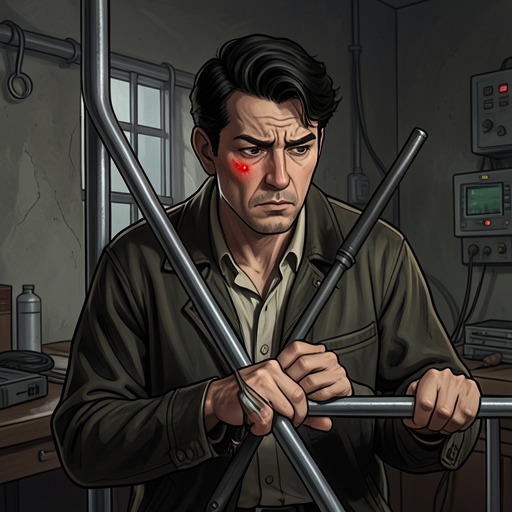
The fixation develops amid the ordinary confinement of the cell. The Unnamed protagonist moves between its door, the mirror over the washbasin, and the wall; the mirror shows both his face and the wall behind him. After looking at his bloodshot eyes, he leans close to inspect the pimple on his cheek. He believes it has grown substantially since he last examined it. Even touching it brings sharp pain, and his body stiffens as he resists the impulse to claw at it. His attention narrows until the blemish seems to command both his hands and his gaze.
In another episode, he stops before the mirror and presses the blemish until a small amount of fluid appears. The attempt does not satisfy him: he cannot clear it, and he continues to think of it as something that will not go away. He changes the angle of his head, searching for a visible sign that it is ready to come to a head, then leaves the mirror and sits on the edge of the bed. This return to the bed does not resolve the fixation. It only interrupts an effort he expects to resume.
The mirror gives the episode a repeated structure. The Unnamed protagonist approaches, inspects, touches, and withdraws, then comes back to the same reflected face. The object of attention is physically small, but the repeated examination makes it occupy the scene. In the cell, where the available setting is limited, the mirror and washbasin provide a fixed place for an effort that can be resumed but not easily concluded.
Escalation and Repeated Effort
The later attempt begins with close examination of the swollen blemish and a sense that something is lodged beneath the skin. The Unnamed protagonist washes it with hot water, dries it, and tests its edges with his fingers. He has no pin or needle in the cell, so he has to continue by hand, repeatedly stopping when the pain becomes too much and then beginning again. The account emphasizes the repeated adjustments and pauses: he tries to find a workable position, catches his breath, and returns to the task.
Eventually, he presses hard enough for the contents to emerge. He watches closely, uses toilet paper to remove what has come out, and returns to the blemish to see whether more remains. Rather than ending when the first material is removed, the process continues through further attempts. He studies what he has removed and then examines the affected area again, intent on clearing it completely. The sequence is presented as laborious and absorbing, not as a quick cure.
After removing the central mass, he inspects it in his palm and tests its firmness, then checks his cheek for anything left. He continues to press and wipe until only blood and water come out. Finally, he puts the extracted material into the toilet and watches it disappear as the water is flushed. The small act of disposal closes this particular episode: the thing he has watched and handled is gone from sight, and he has achieved the removal he was pursuing.
A Limited Victory and the Return of the Cycle
The removal does not produce a lasting resolution. The Unnamed protagonist looks again at his cheek and starts to poke at the remaining blemish, but stops because it is not ready. The episode therefore ends with restraint rather than a declaration that the problem has been permanently solved. One focus has been removed; another remains, awaiting the conditions that will make it the next object of attention.
That ending gives the fixation its cyclical force. Earlier, pressing the pimple yields little and leaves him convinced that he cannot get rid of it. Later, a much more prolonged effort culminates in its removal, but the closing glance returns him to the possibility of another attempt. The difference is real—the central mass is gone—but the pattern of inspection and anticipated action has not disappeared. The moment of success marks a local ending, not an escape from recurrence.
Narrative Significance
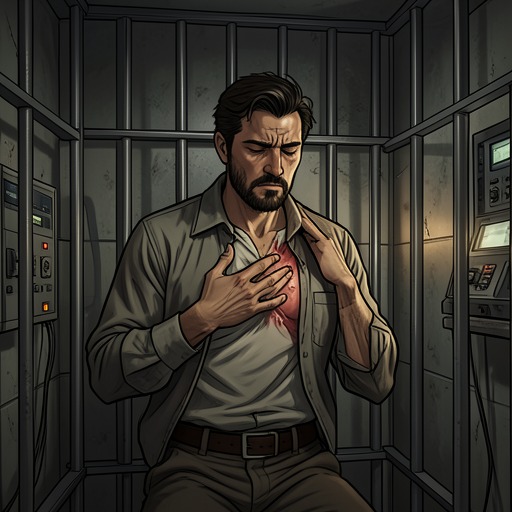
The blemish also stands out because the Unnamed protagonist’s attention to it is set beside his anger. During the earlier inspection, pain and the urge to attack the pimple give way to rage directed at the men he curses as he moves through the cell. The narrative places these states in close succession without making the blemish the sole explanation for his hostility. Instead, the abrupt shift shows how bodily irritation and broader fury coexist within the same confined space, each commanding his attention in turn.
The fixation makes an everyday imperfection into a problem that seems to demand complete control. The Unnamed protagonist searches, tests, presses, and checks for any remnant; even after removal, he studies the result and inspects the site again. Yet the final blemish that is not ready cannot be forced into the same ending. That contrast—one problem painstakingly cleared, another left to wait—gives the episode its uneasy conclusion. The effort can produce a visible result, but it cannot guarantee that the cycle of scrutiny and frustration is over.